As planetary petrologists, our group interest is the study of meteorite, rover, and orbiter data to better understand our solar system, in particular Mars and the enstatite-rich meteorite parent bodies.
Martian meteorites:
Martian meteorites are the only samples available from Mars (Udry et al., 2020; 2025). Comprehensive petrological studies of these rocks allow us to better understand martian magmatic processes and more broadly, the evolution of the martian interior. Our group currently focuses on 1) Poikilitic shergottites and 2) Nakhlites and chassignites. We also study various newly recovered martian meteorites to constrain their formation on Mars and relationship with other previously studied meteorites.
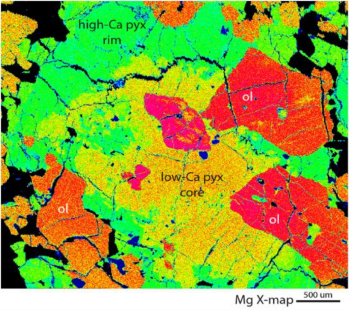
1) Poikilitic shergottites are the main group of martian shergottites (>20%). They are divided in two geochemical groups according to their light rare earth elements (LREE), including intermediate and enriched poikilitic shergottites. This enrichment is linked to their reservoir source, however, the relationship between these two groups as well as with the other types of shergottites is not clear. We are currently conducting a comprehensive study (including mineral, bulk rock, and quantitative textural analyses, melt inclusion investigation, crystallization age,…) of this major group for martian rocks, which could possibly represent a large part of the martian crust (Combs et al., 2019; Rahib et al., 2019; O’Neal et al., 2023). This project includes collaborators from University of Cape Town (South Africa), Scripps Institution of Oceanography at UCSD, Rutgers University, and University of Houston.
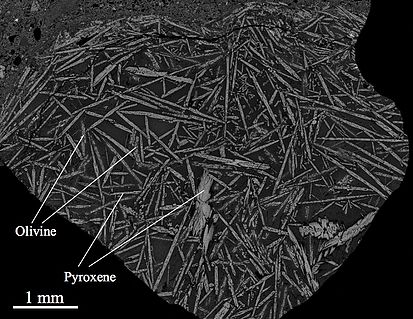
2) Nakhlites and chassignites: Although distinct, these two types of martian rocks (consisting of a total of 35 rocks) show mineralogical, geochemical, and isotopic similarities (e.g., McCubbin et al., 2013). In addition, according to their similar ejection ages, all of these meteorites likely originate from the same location on Mars. After conducting a systematic and comprehensive study of these rocks to better understand their emplacement in the martian crust and their source composition (Udry and Day, 2018), we have been focusing on the evolution of parental melts of these rocks and the relationship between the main minerals found in these rocks (Ostwald et al., 2023; 2024; Ramsey et al., 2023). These projects are in collaboration with Rutgers University and Scripps Institution of Oceanography at UCSD.
Felsic and alkaline rocks on Mars:
The Mars Science Laboratory (MSL) Curiosity has analyzed felsic and alkaline rocks with various textures (Sautter et al., 2015). Due to the lack of plate tectonics on Mars, the presence of such compositions at the martian surface is puzzling. Using thermodynamical softwares, such as rhyolite-MELTS, we are aiming to better constrain the formation of these rocks, including their parental source and fractional crystallization and/or assimilation conditions (Ostwald et al., 2022).
Mars 2020 Perseverance rover at Jezero crater:
The Perseverance rover landed at Jezero crater on February 18th 2021. Mars 2020 encounters various igneous rocks during its first year on the Red planet, including the Máaz and Séítah formations (e.g., Udry et al., 2022; Beyssac et al., 2023). The Máaz formation was shown to be a series of lava flows and pyroclastic rocks, whereas the Séítah formation represent olivine-rich cumulate rocks that might or might not related to the Máaz formation. During the rest of the traverse, Jezero explored the fan unit and the margin unit, where the SuperCam instrument have been measuring igneous detrital minerals in sedimentary rocks. Dr. Udry have been a Participating Scientist on the Mars 2020 mission since 2021 and have been helping with analyzing and interpreting date on igneous rocks and minerals since then.

Aubrite meteorites as mercurian analogs:
The MErcury Surface, Space ENvironment, GEochemistry, and Ranging (MESSENGER) spacecraft has revealed important characteristics of Mercury’s surface mineralogy and composition, such as a low FeO content and highly reduced formation conditions (-5 to -7 below the Iron-Wüstite buffer) (e.g., Nittler et al., 2011; McCubbin et al., 2012; Weider et al., 2014). We likely do not possess mercurian meteorites, however, the enstatite-rich meteorites, including aubrites, enstatite chondrites, and enstatite chondrite impact melts, show similar reduced conditions of formation, composition and mineralogy to those analyzed and inferred, respectively, on the mercurian surface. We are conducting a comprehensive petrological and geochemical study of the enstatite-rich meteorites, including newly recovered samples, which have never been previously analyzed, to better understand behavior of elements and melt evolution at highly reduced conditions and to assess if these meteorites are appropriate mercurian analogs (see Udry et al., 2019). If so, combining MESSENGER and enstatite-rich meteorite data will help better understand mercurian magmatism and how its interior evolved (Wilbur et al., 2022).

 eXtraterrestrial Petrology LAB (XPL) at UNLV